
WELCOME BONUS 300%
UP TO €2000 + 100
FREE SPINS
UP TO €2000 + 100
FREE SPINS
Home → Games
Casino games at Winbeatz
Read Statistics of Last 500 Rounds Correctly
Understanding the theoretical return to player (RTP) is crucial for informed gameplay. For instance, Craps Pass Line (and Come) offers an RTP of 98.59%, meaning that over a vast number of rounds, approximately 98.59% of all wagers are returned to players. This figure is derived from complex mathematical calculations based on the probabilities of each dice roll outcome. Players should recognize this as a long-term average, not a guarantee for any specific session.
The house edge is the inverse of the RTP, representing the casino's average profit margin on a given game. Craps Don't Pass (and Don't Come) features a slightly lower house edge of 1.36% compared to the Pass Line's 1.41%. This minuscule difference can become significant over extended play. For example, a $100 bet on Don't Pass might theoretically return $1.36 less than the initial wager on average, whereas the Pass Line would return $1.41 less.
When evaluating games, it is essential to consider their mathematical structure. Casino Hold'em Ante + Call, for example, has an RTP of 99.18% per circulation but a house advantage of 2.16% on the Ante bet. This difference arises because the average bet is 2.64 times the Ante, thus altering the effective house edge. A player aiming for the lowest possible house advantage would scrutinize such variations.
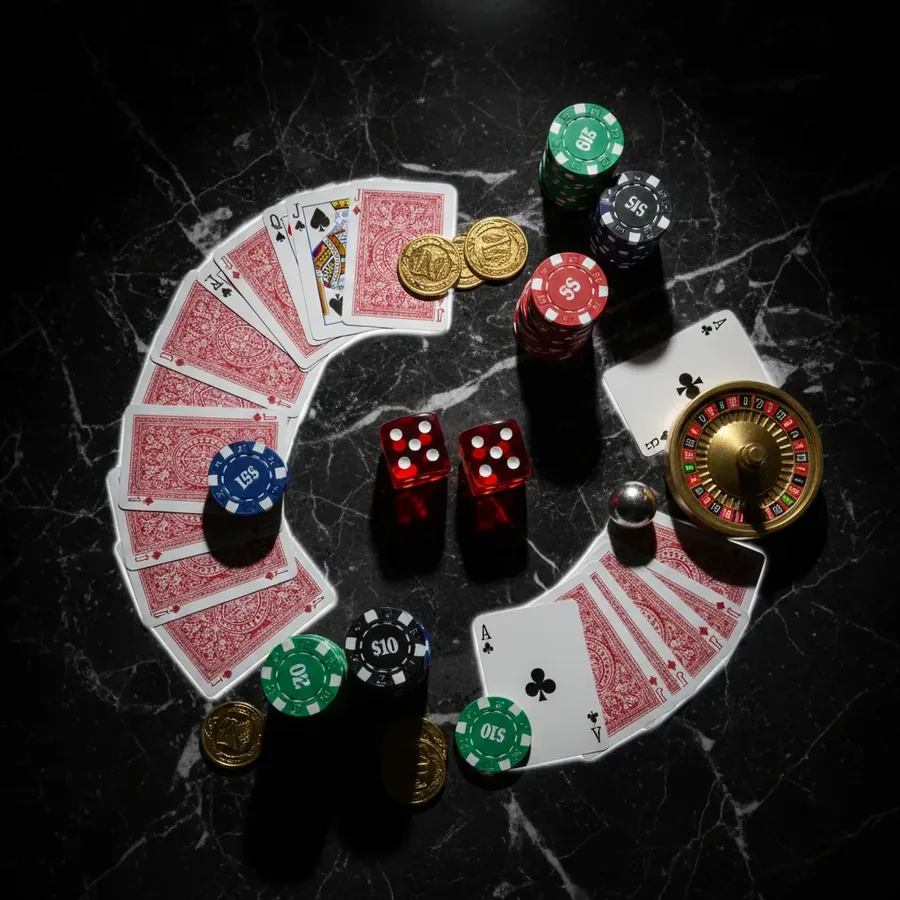
House Edge and RTP: Two Names for the Same Number
The return to player (RTP) and house edge are two sides of the same coin, defining the mathematical relationship between a player and the casino. For Blackjack with 6 Decks, S17, DAS, DOA, and a 3:2 payout, the RTP is 99.54%, equating to a house edge of 0.46%. This means for every $100 wagered on this specific Blackjack variant, the casino expects to retain $0.46 on average over an extensive period.
Different game variations present varying RTPs and house edges, impacting player returns. French Roulette, without La Partage for inside bets, has an RTP of 97.30%, resulting in a house advantage of 2.70%. This is a standard European roulette edge, as the wheel has 37 sectors. A player betting $100 on a single number would theoretically lose $2.70 on average over many spins.
The mathematical advantage can be substantial even in seemingly favourable games if specific rules are altered. A Blackjack game with a 6:5 payout instead of the standard 3:2, even with 6 decks, sees its RTP drop to 98.15%, increasing the house edge to 1.85%. This means a $10 Blackjack payout would be $12 instead of $15, a significant reduction for the player.
Soft 17: the Ace counts 11 or 1
The rule regarding Soft 17 in Blackjack significantly influences the game's mathematics and player advantage. In a variant where the dealer stands on Soft 17 (S17), the house edge is approximately 0.46%, as seen in Blackjack with 6 Decks, S17, DAS, DOA, and a 3:2 payout. This rule is favourable to the player because it limits the dealer's ability to improve their hand.
Conversely, if the dealer hits on Soft 17 (H17), the house edge increases. This means that hands where the dealer has an Ace and a 6 can be further improved, potentially leading to more player losses over time.
The strategic implications of the Soft 17 rule are important for players using basic strategy. For instance, the Blackjack Liberal Vegas Strip variant, which includes S17 along with DAS and Resplit, offers the lowest house edge at 0.28%. This favourable combination of rules, including the dealer standing on Soft 17, maximises the theoretical return to player.
Declining Insurance: The Most Common Blackjack Mistake
The insurance side bet in Blackjack is often a statistically disadvantageous option for players, increasing the house edge. It is a bet on whether the dealer has Blackjack, offering a 2:1 payout.
For example, in Blackjack with 6 Decks, S17, DAS, DOA, and a 3:2 payout, the main game has a house edge of 0.46%. Insurance, however, is generally considered to have a house edge closer to 7.5% when the dealer's upcard is a 10-value card or an Ace. Making this bet frequently erodes a player's bankroll much faster than playing the main hand.
The data does mention Blackjack Surrender (Late Surrender) as a rule modifier that improves RTP by approximately 0.08 percentage points. Unlike insurance, which is an additional bet, surrender allows a player to forfeit half their bet after the dealer checks for Blackjack, a decision that can be mathematically sound in certain situations.
Straight 35:1 Against the Chance of 1 in 37
The payout for a straight bet in European Roulette, which has 37 sectors, is 35:1. This means for every $1 wagered on a single number, a win returns $35 in profit, plus the original $1 stake, for a total of $36. The chance of hitting a specific number on a single spin is 1 in 37.
This 35:1 payout structure on a 1-in-37 chance results in a house edge of 2.70% for European Roulette. For instance, if a player bets $100 on a single number and wins, they receive $3,500 profit. However, over many spins, the casino expects to retain $2.70 for every $100 wagered on average.
Comparing this to American Roulette, which features an additional '00' sector making 38 sectors in total, the chance of hitting a single number is 1 in 38. Despite the payout remaining 35:1, this increases the house edge to a substantial 5.26%. This makes the single number bet in American Roulette significantly less favourable for the player.
Game categories at a glance
| Category | Examples | Stakes From | Highlight |
|---|---|---|---|
| Slots | Buffalo Power: Hold and Win, Jammin' Jars, Esqueleto Explosivo 2 | 0,10 EUR | thousands of titles |
| Table games | Roulette, Blackjack, Baccarat | 0,50 EUR | classic rules |
| Live casino | Speed Baccarat, Crazy Time | 0,20 EUR | real dealers |
| Jackpot games | Mega Moolah, Divine Fortune, Age of the Gods | 0,20 EUR | progressive pools |
| Instant games | Aviator, Plinko, Mines | 0,10 EUR | fast rounds |
| Video poker | Jacks or Better, Deuces Wild | 0,25 EUR | strategy based |
Variance at the Table: 1:1 vs. 35:1
French Roulette features a straight bet payout of 35:1, offering a substantial return for a single number win. This game, with 37 sectors on the wheel, maintains a European edge of 2.70%. A €10 bet on a single number could yield €350 in winnings, plus the original stake. The high payout ratio reflects the risk associated with such a precise wager.
In contrast, many side bets and specific outcomes in games like Sic Bo can offer payouts as low as 1:1. For instance, a 'Single Number' bet in Sic Bo, where the number appears once, pays 1:1. This means a €10 bet would only return €10 in winnings. Such low multipliers significantly reduce the potential return on investment for players.
The disparity between a 35:1 payout on a single number in French Roulette and a 1:1 payout in other scenarios highlights the varying risk and reward profiles available. Players seeking larger potential wins might favour games with higher individual payout ratios, while those preferring more frequent, albeit smaller, returns may opt for games with lower payout structures.
Baccarat commission: 5 percent on each Banker win
In Baccarat, the Banker bet is often subject to a commission, typically 5 percent, on winning bets. While the Banker bet has a theoretical RTP of 98.76% (8 Decks), this commission effectively reduces the payout. A €10 winning Banker bet, after the 5% commission, would return €9.50 in profit. This is a standard mechanic in many Baccarat games.
The Player bet in Baccarat, conversely, typically pays 1:1 without any commission. With an RTP of 98.76% (8 Decks), the Player bet offers a direct return of the stake plus an equal amount in winnings. For a €10 bet, this results in €10 profit. This absence of a commission makes the Player bet more straightforward in terms of immediate returns.
The commission on Banker wins is a crucial factor for players to consider when choosing their bets in Baccarat. While the Banker hand statistically occurs slightly more often, the 5% commission can erode potential profits over time, making the Player bet a more consistent, albeit slightly less statistically favourable, choice in terms of immediate payout.
Why the Double Zero Almost Doubles the House Edge
American Roulette, featuring both a '0' and a '00' sector, presents a significantly higher house edge compared to its European counterpart. With 38 sectors in total, the house edge for American Roulette stands at 5.26%. This is a substantial increase from the 2.70% edge found on European Roulette wheels.
The addition of the double zero directly impacts the probability of winning for outside bets such as red or black. While payouts remain the same as on a single-zero wheel (e.g., 1:1 for red/black), the increased number of sectors means the casino retains a larger portion of wagers over the long run. The house edge effectively doubles due to this extra sector.
For players, this means that for every €100 wagered on American Roulette, the theoretical expectation is to lose €5.26, whereas on a European Roulette wheel, the theoretical loss would be €2.70. This difference highlights the importance of choosing games with a lower house edge whenever possible to maximise playing time and potential returns.
37 vs. 38 Sectors: One Zero Difference
European Roulette, also known as French Roulette, operates with 37 sectors on its wheel, numbered 1 through 36 plus a single '0'. This configuration results in a house edge of 2.70%. The payouts for various bets, such as 35:1 for a straight-up number, are standard across most roulette variants that do not feature a double zero.
American Roulette, in contrast, includes an additional '00' sector, bringing the total number of sectors to 38. This single extra sector significantly alters the game's mathematics, inflating the house edge to 5.26%. The mathematical impact of this additional sector is substantial for the casino's advantage over players.
The difference of a single zero sector between these two popular roulette variants has a direct impact on the player's return. A game with 37 sectors offers better odds for the player than a game with 38 sectors, assuming all other rules and payouts are identical. This makes European or French Roulette generally more favourable for players.
Player pays 1:1 without any commission
In Baccarat, the 'Player' bet offers a straightforward payout of 1:1, meaning a winning €10 bet returns €10 in profit. This bet does not incur any commission, unlike the 'Banker' bet, which typically has a 5% commission deducted from winnings. The RTP for the Player bet is 98.76% (8 Decks).
This 1:1 payout structure makes the Player bet easy to understand and calculate potential winnings. For example, a €50 winning Player bet would result in an additional €50 in winnings, for a total return of €100. The absence of a commission means the entire payout is directly attributable to the stake wagered.
While the Banker bet often has a slight statistical advantage, the absence of commission on the Player bet provides a clear and immediate return without any deductions. This makes it an attractive option for players who prefer simplicity in their betting and immediate clarity on their winnings.
100 EUR bet, 50 rounds: the expected value
A 100 EUR bet across 50 rounds on Video Poker Jacks or Better 9/6 (Full Pay) with an optimal strategy results in an expected value calculation. The theoretical Return to Player (RTP) stands at 99.54%, leaving a house edge of 0.46%.
With a 0.46% house edge, the casino retains an average of 0.46 EUR for every 100 EUR wagered over the long term. Over 50 rounds, each with a 100 EUR bet, this amounts to a theoretical average retention of 50 x 0.46 EUR = 23 EUR.
This calculation demonstrates that for every 50 rounds of 100 EUR bets, players can statistically expect to retain approximately 4,977 EUR of their initial 5,000 EUR stake, based on the game's RTP. Deviations from optimal strategy can increase the house edge and reduce player returns.
Punto Banco: 5 Percent Commission on Banker Wins
In Punto Banco, a commission of 5 percent is applied to winning Banker bets. This commission is a standard feature in many Baccarat variants and directly impacts the house edge on this particular wager.
The Player bet in Baccarat, with a RTP of 98.76% and a house edge of 1.24% over 8 decks, does not incur this commission. The Banker bet, despite the commission, often remains a preferred choice due to slightly better probabilities in the long run.
This 5% commission effectively increases the house's advantage on Banker wins, altering the overall mathematical expectation for players. For instance, a 100 EUR winning Banker bet would result in a 95 EUR payout after the commission is applied.
Pass Line in Craps: Process in Four Steps
The Pass Line bet in Craps is a fundamental wager with a Return to Player (RTP) of 98.59%, indicating a house advantage of 1.41%. This bet is resolved in a series of distinct stages, beginning with the come-out roll.
Initially, a player places a bet on the Pass Line. If the come-out roll is a 7 or 11, the bet wins immediately. However, if the roll is a 2, 3, or 12, the bet loses. Any other number rolled establishes a 'point'.
Once a point is established, the shooter continues to roll the dice. The Pass Line bet wins if the point is rolled again before a 7 appears, and loses if a 7 is rolled first. This probabilistic outcome is central to the game's engagement.
Hold or discard five cards: the decision
The decision to hold or discard specific cards in Video Poker, such as Jacks or Better 9/6, is guided by optimal strategy to maximize the Return to Player (RTP). This strategy is crucial for achieving the stated RTP of 99.54%.
For example, holding a pair of Jacks while discarding the other three cards in a hand like J-J-7-8-9 aims to improve the chances of forming a better hand, such as Three of a Kind. This strategic choice is based on the probability of drawing favourable cards.
Incorrectly discarding or holding cards can significantly increase the house edge. For instance, failing to hold a Full House combination in favour of aiming for a higher payout like a Royal Flush would lead to a lower RTP than the optimal 99.54%.
Table Games Often Count Only 10 Percent
When participating in bonus promotions, table games such as Roulette Amerikanisch and Blackjack may contribute only 10 percent towards fulfilling wagering requirements. This means a 100 EUR bet on these games counts as only 10 EUR towards the total turnover.
This reduced contribution rate is a common term in bonus offers, designed to balance the lower house edge often found in table games compared to slots. For example, with a wagering requirement of 40 times the bonus amount, a significant number of table game bets are needed.
To illustrate, to meet a 4,000 EUR wagering requirement by betting exclusively on table games where bets count at 10%, a player would need to wager a total of 40,000 EUR. This contrasts with slots, where 100% of the bet typically counts towards wagering.
Contact
Live - online chat
Banking









Providers












Winbeatz Casino 2026